

Twelve questions a plan has to be able to answer.
It isn't a service or a menu: it's the checklist you check what you're already doing against. Whichever one you can't answer is the hole.

18 years at Grupo Modelo · Corona global +30% · From #8 to #1 · 3 Effie de Oro
Before you spend, find out what evidence exists to make it.
The evidence, in ten seconds
They sold you the solution without measuring the problem. We start there.
Four kinds of decisions
We're the layer between information and the decision. Not another database, not another research house, not another agency. You bring the decision you're about to make; we tell you what evidence already exists, what's missing, and what can be concluded with what's there.
Behind it, six pieces work together that you don't have to learn. Open them up if you're curious how →
The TDI ecosystem · one system, six modules
That's why you only have to remember one name. What follows is what happens between you bringing a decision and us answering it with evidence you can trace.
ORA.01 · decides
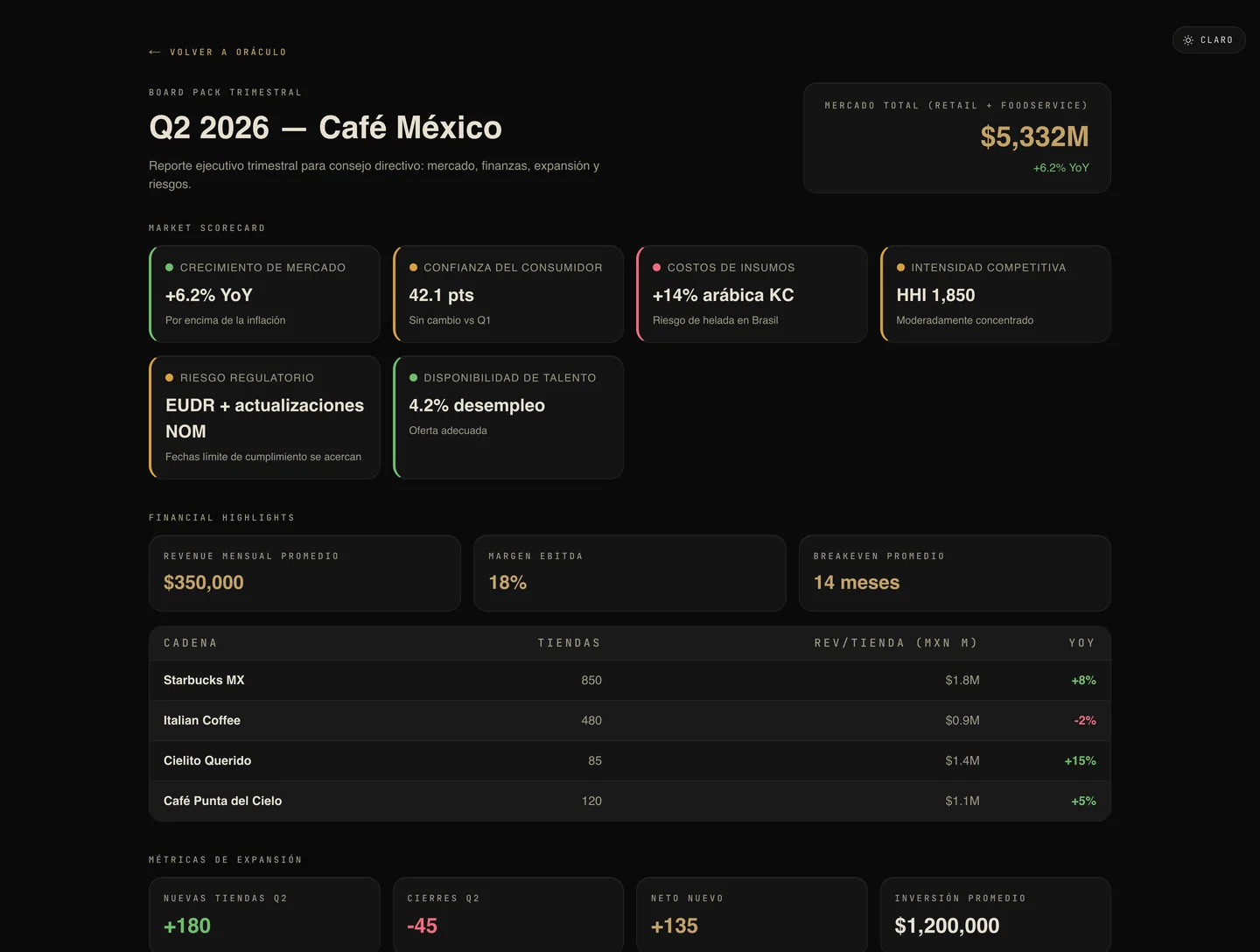
Ask in Spanish; it answers with the number and where it came from.
 The tool →
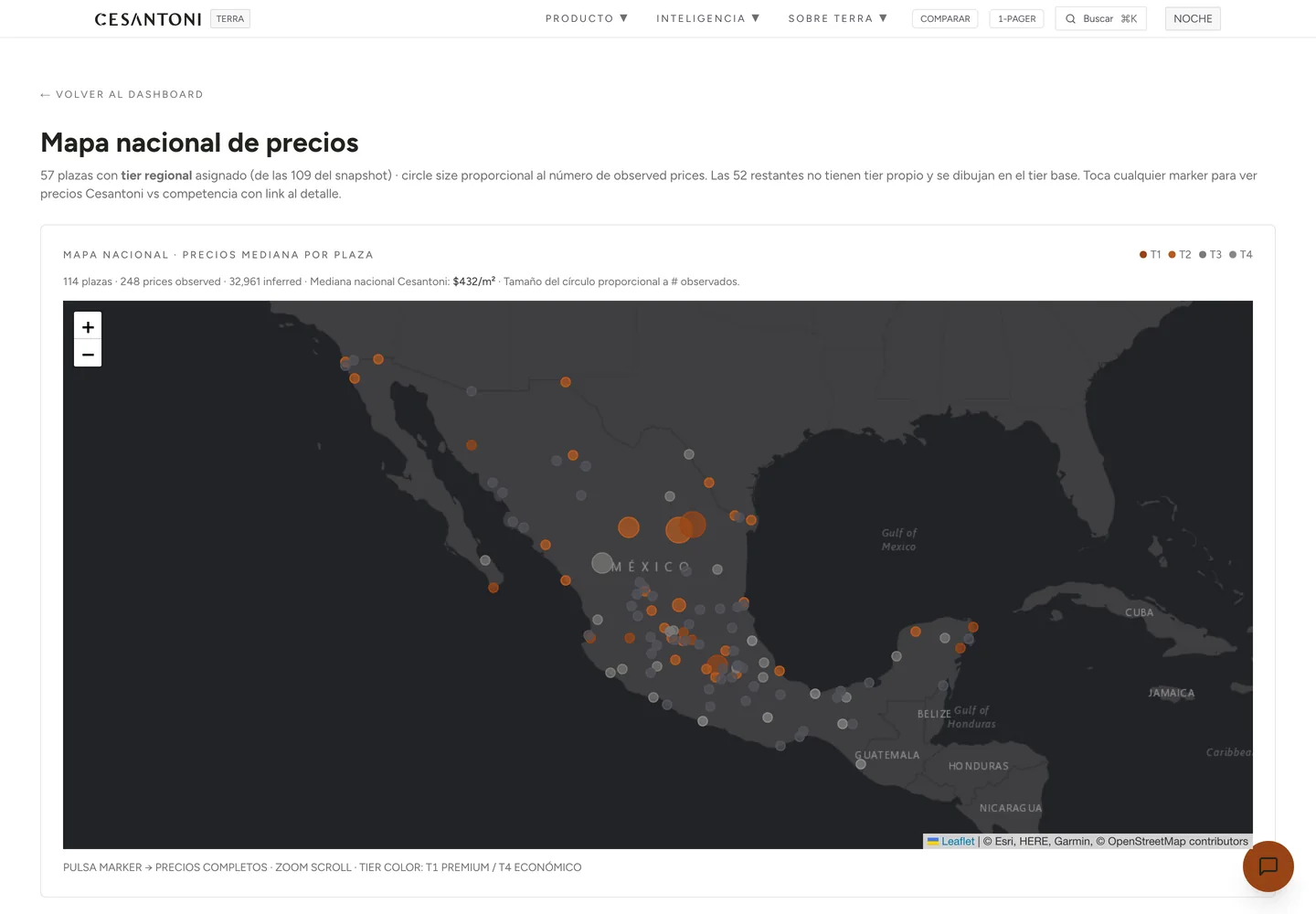
TER.04 · locates
Which market to open first, with which model, and how many months to pay it back.
 The tool →
HUM.05 · simulates
Test your concept and your price before paying for fieldwork.
 The tool →
NOR.06 · activates
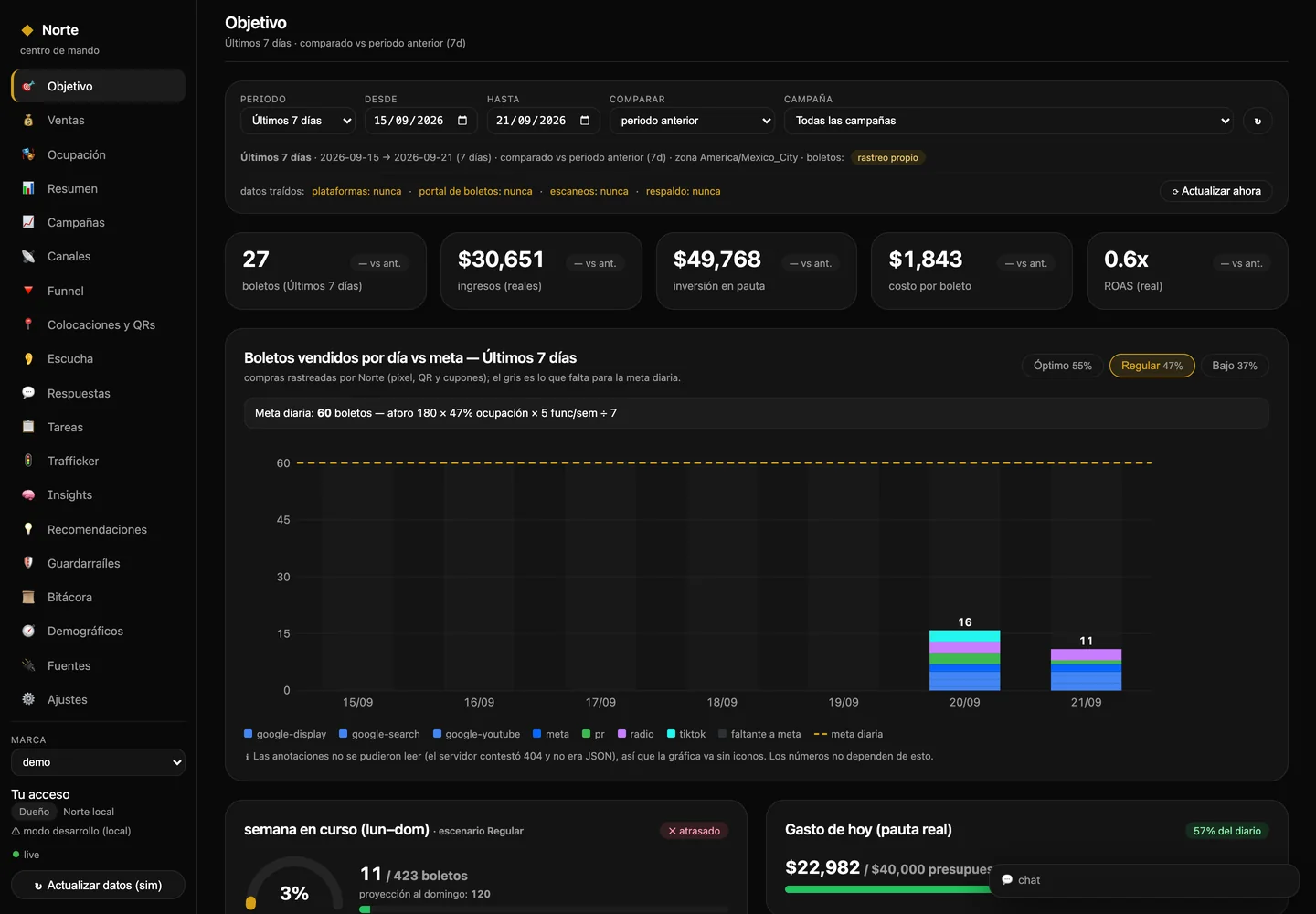
What you spent, what you sold, and what they say about you — brand by brand.
 The tool →
Hover over a module: it opens in its box. The orbit pauses while you read.
 Serebrofindsthe evidence that already exists
 Granomeasuresso the number doesn't change
 Terralocatesmarket by market
 HUM△NSsimulatesbefore the market makes you pay for the mistake
 Norteactivatesand leaves a record of who moved what
 Oráculodecidescomplete with its source, its year, and its grade
The TDI ecosystem
Cases
Not two anonymous "a leading brand in the sector." Each one with its problem, the intelligence that was built, the finding, and what it made possible to decide.

It sold through distributors nationwide and had no way to see, in the same month, what price each one was charging. The gap only showed up once the sale was already lost.
We surveyed the country's 109 markets —where the brand has 166 distribution points— and collected 4,359 public prices across 16 distributors, laid out in the same row and the same unit.
29 products show up in two or more stores at the same time, and the same shelf in the house was selling with up to a 63% gap between one distributor and another. None of those gaps were authorized.
It stops being a debate over perceptions: now it's known which SKU, in which store, and how big the gap is. The decision —renegotiate, match it, or leave it— belongs to the client, with the row right in front of them.
Cesantoni is one of three clients —along with Bepensa and BIA— whose brands grow +20% in sales on average across retail and e-commerce. That's the client's business context, not a result we measured as our own.
The gap stopped showing up only after the sale was lost. Now it's visible the same month.
The census here is of Mexico because the client's market is Mexico. The method isn't: it's built on whichever country is needed.


Each country reported its category with its own definition, its own cutoff, and its own currency. Adding them up produced a number nobody could defend in the regional meeting.
The coffee category across eight countries, with the same metric definition, the same cutoff, and the stated currency — delivered as navigable material, not a PDF you have to request.
Comparing countries stops being a translation exercise.
It arrives on its own, every month since August 2026: this month's number sits next to last month's without anyone re-checking how it was calculated.
The regional number is now defended in the meeting on its own. And next month's arrives by itself.
Illustrative example · Maturity scale · 0 to 5 · it cuts off at the first incomplete level, it isn't averaged
This doesn't get fixed with a redesign.
It's fixed at block 12.
The numbers above are a sample case, not a client. Yours comes from your own operation.
It isn't a service or a menu: it's the checklist you check what you're already doing against. Whichever one you can't answer is the hole.
Is there a real tension behind it, or just a pretty data point?
Do you know who you're talking to, by name and behavior?
Is the positioning defined, or improvised with every campaign?
Are the business objectives written down and prioritized?
Did you assess what enables you and what holds you back, inside and out?
Do you know where and how to connect, or do you buy the usual?
Does the brief steer the work, or do you write it at the end?
Is there a process, or just opinion meetings?
Does the product get a seat in the marketing conversation?
Does activation execute the strategy, or replace it?
Does what's new reach the market, or stay in the deck?
Does it get measured again at the close, with the same yardstick?
HUM△NS · proprietary technology
The campaign is tested against a simulated panel —generated from your category, not replicas of real people— before you spend the budget. It's in beta: without a field data point to check it against, the report ships marked "not calibrated." It doesn't replace fieldwork: it tells you which one deserves it.
Not for sale. Runs only for our clients.
How they fit together
Serebro finds · Grano measures · Terra locates · HUM△NS simulates · Norte activates · Oráculo decides
The problem isn't getting an answer: it's knowing whether the data exists, where it came from, and whether it will say the same thing tomorrow. That's why we publish the sources that fail, and the platform never fills a gap with something plausible: if a number is there, it can be traced back to its origin. And every number states what it can be compared against: those prices run chain against chain, they don't describe the price of a country.
TDI / SER.02 · finds
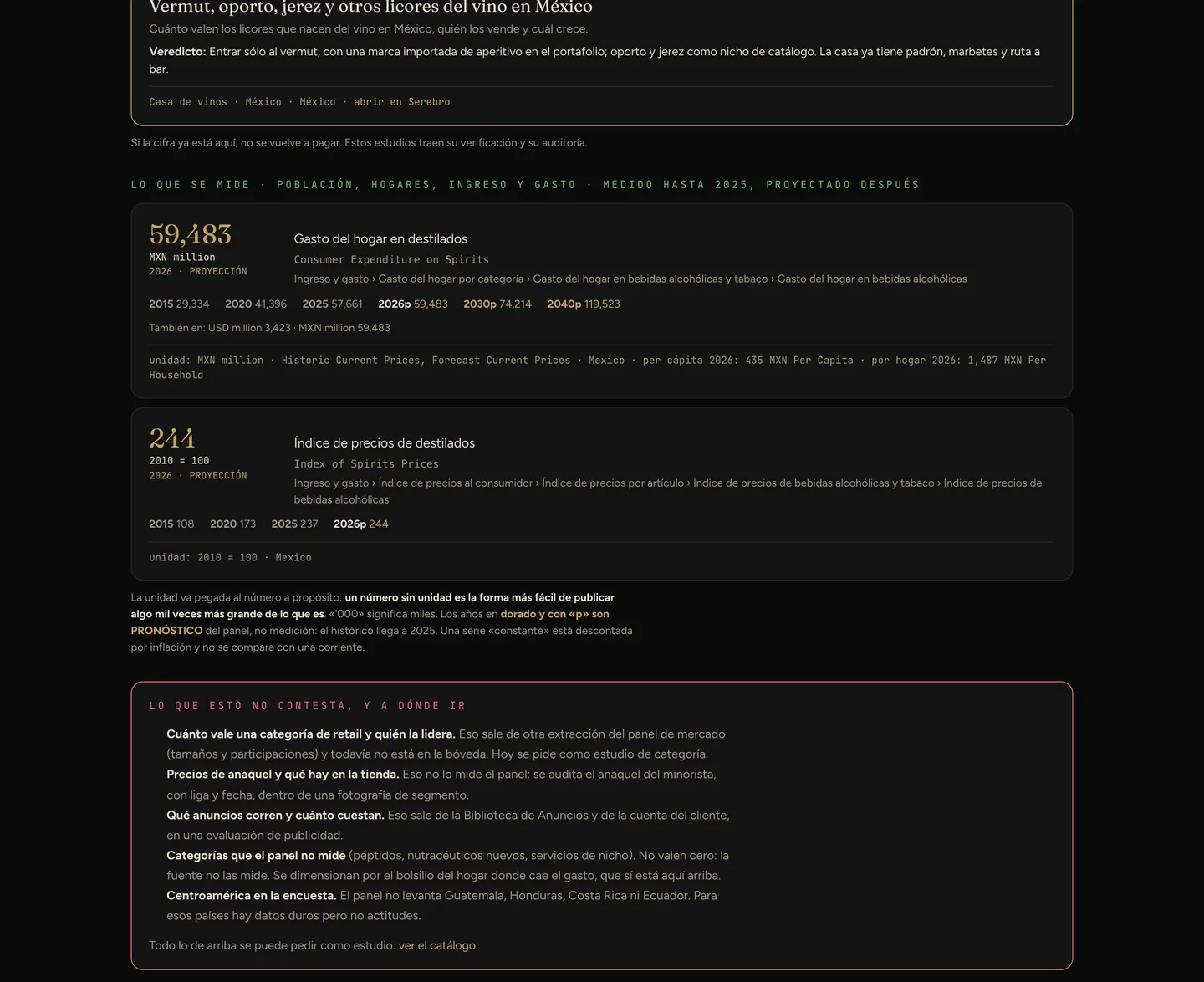
The vault: every category with its source and year
It's the vault, and it doesn't calculate anything: it draws what's there. Every entry keeps its metric's definition, its source note, and its exact address — size, growth, channel, and brands, with their year and their grade. Soft drinks and health and wellness run worldwide on the licensed panel; the other nine industries —coffee, dairy, snacks, and the rest— have it licensed for the Americas. Alcohol does reach beyond the continent: outside that panel it's built from open sources —207 countries with WHO consumption data and 168 with Comtrade trade data—, and the page states which of the two it's looking at. Alongside it, a licensed consumption panel —a lifestyle survey, 40 countries, 2024, 2025, and 2026 cuts, queryable by question and by age, gender, and income cut—. Calibration doesn't come from nowhere: it comes from there.
See the datasheet →TDI / GRA.03 · measures
So the number doesn't change between meetings
Every number is resolved against a fixed definition —which metric, which universe, which period, which source— and not against how you phrased the question; the interface shows you which one answered you. If your question admits two definitions, it doesn't choose for you: it shows you both. And when the source updates, the number changes and what changed is written down.
See the datasheet →TDI / HUM.05 · simulates
Test your concept and your price before paying for fieldwork
Concept test, conjoint, price sensitivity, and a qualitative guide —what you'd normally commission from a research house— with a simulated panel and a fixed seed. It tells you which one wins, with which cohort, and through which lever, and then it's put through six checks and it publishes the ones it fails: in one test run it failed two and simply wrote «do not deliver as conclusive». It already runs on the platform's published studies. It's marked as beta and that's how we say it in the catalog: it orders hypotheses before you spend on fieldwork, it doesn't replace it.
See the datasheet →TDI / ORA.01 · decides
Ask in Spanish; it answers with the number and where it came from
Serebro answers the standalone question; Oráculo is where that answer becomes a deliverable —Oráculo integrates Serebro when it needs to locate the evidence, and each one can be hired on its own—. Census, trade in your area, trends, shelf pricing, and the ads running today, in Spanish. You write the question and it answers with the number, its source, and the year the data refers to; if it doesn't have it, it says so. When more than a single number is needed, the same team builds the study, and every slide carries its own «what this slide CANNOT claim» section.
See the datasheet →TDI / NOR.06 · activates
All your brands: what you spent, what you sold, and what they say about you
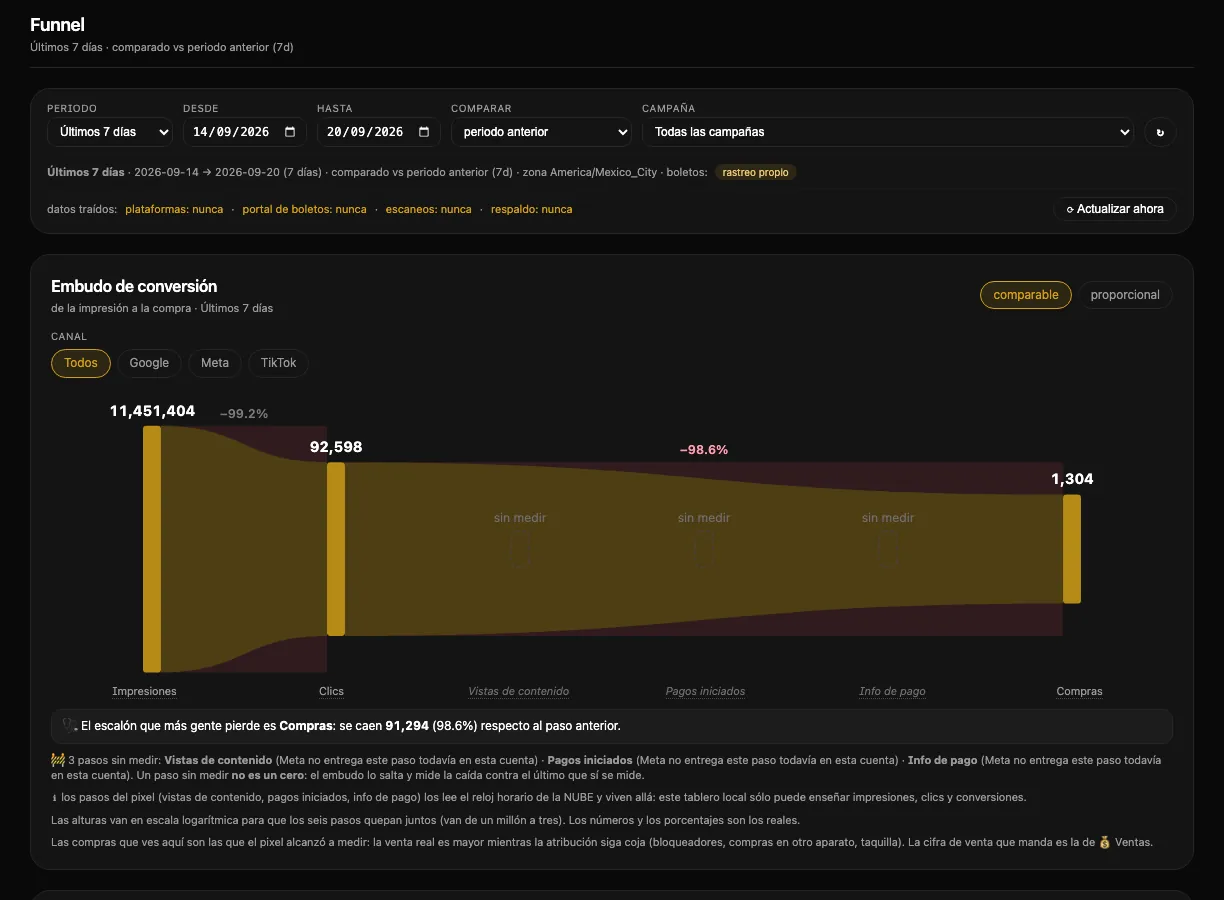
One brand, one control tower: digital media, offline media tracked with QR and coupon —what can be tracked, and the dashboard says how much it is—, what the public says about you, and the log of who decided what, at what time. The real sale sits next to the spend. It ingests every hour with no one at the keyboard — and it writes the recommendation in plain language, with its estimated impact in pesos and an approve button.
See the datasheet →TDI / TER.04 · locates
Which market to open first, with which model, and how many months to pay it back
Every market for every product, rated 0 to 100 with the books open on how that rating was built: total and reachable market, the recommended entry model, the investment, how many months to pay it back, the census competitors, the risks, and the next step. The client doesn't come in to ask an AI — they come in to see their territory.
See the datasheet →And it doesn't arrive the same for everyone
Your categories, your markets, your competitors, and the data you ask for — not a generic dashboard with a different logo on top.
And the deliverables come out in the format you're going to present them in, not ours. Fitting the platform to how you work is part of the job.
That's why
We're the layer between information and the decision — and the six pieces have names because they're ours, not a license with a different logo.
The six, with their screens →A real run · 4.7 seconds
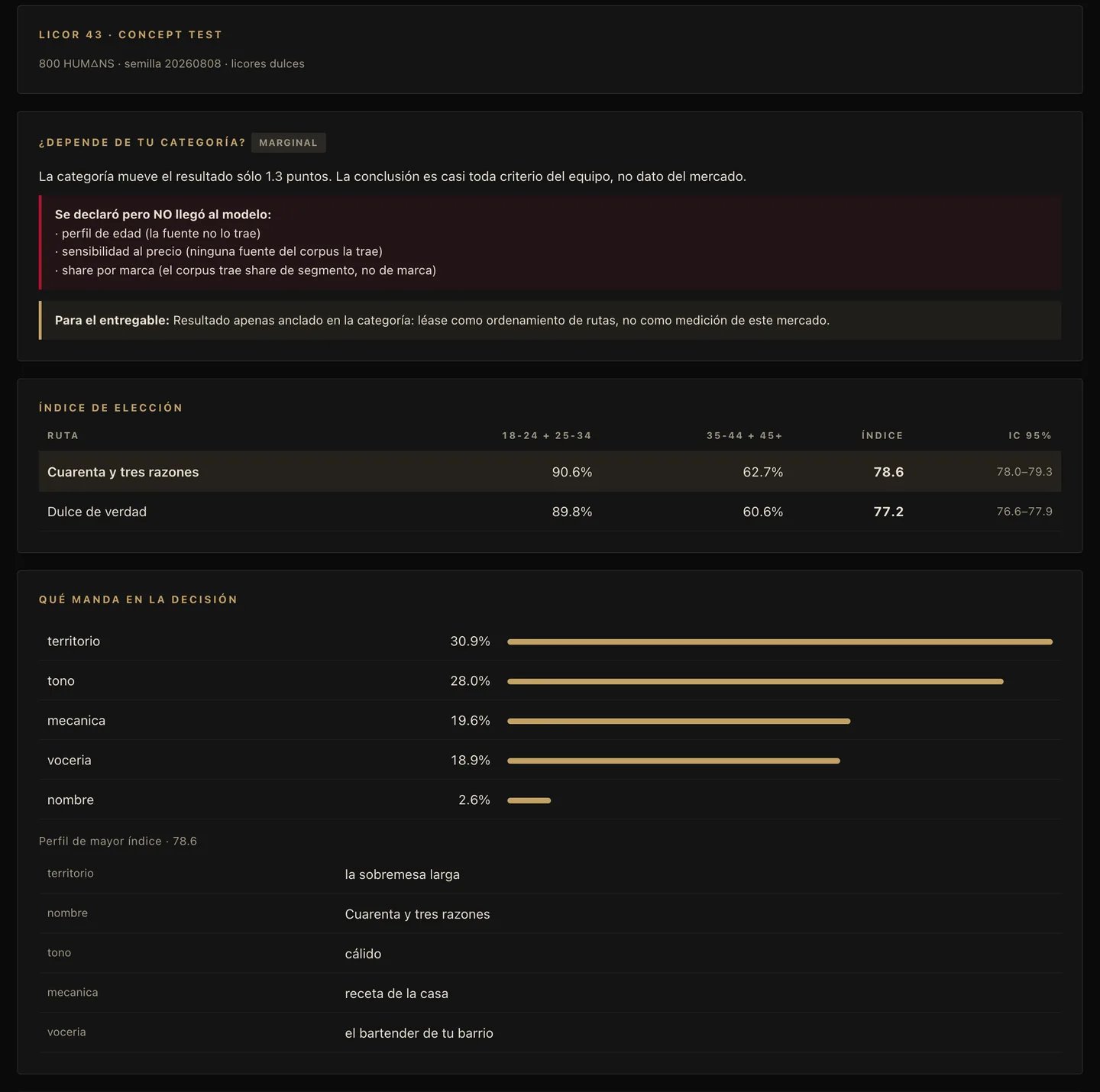
Two campaign routes, one winner — and a verdict that refuses to sign off
And what drives the decision: territory 30.9% · tone 28.0% · mechanics 19.6% · voice 18.9% · the name, 2.6%.
Verdict the study itself wrote: "Fails T5 and T6. Do not deliver as conclusive without correcting."
MEASURED 0DERIVED 4JUDGMENT 6
That's where the difference is, and it isn't the winner: it's that the system refuses to sign off. The two intervals above don't even overlap, and even so it won't sign off: the anchoring test fails because no real data was declared to check it against. A vendor looking to get paid hands you "Route A won." This hands you "it won by 1.4 and don't believe it yet" — and it tells you what data to bring to make it count. Runs in your browser, no sign-up.
Run one now →Free · before we quote you anything
Not a demo. Not an audit of your agency. A marketing decision you're about to make — and we hand you back a photograph of the evidence that exists today to make it. Free, and before we've talked about money.
Three to five signals that already exist about your decision, each with its source and its date. Not opinions: data you can verify.
What nobody measures yet about your question. This is where most vendors improvise; we write it down.
High, medium, or low. A verdict, not a nuance. If it's high, you may not need us: just decide.
What would need to be measured to take that decision from low to high, and how long it takes. That's where the money conversation starts, not before.
What we don't tell you for free is what to do. That takes work and it's billed. What we do tell you: whether you have enough to decide today, or you're about to decide blind.
The entry-point product
One question. One decision. One fixed deadline. No subscription, no marriage, and no holistic strategic digital transformation.
If you hire the 90-day pilot within 30 days, the Sprint is credited in full. We don't want to sell you a diagnosis: we want the decision to get made.
So how much does it cost?
We're not going to put it here, for the same reason this page starts the way it does. Quoting before knowing what decision you're bringing is quoting without diagnosing — which is exactly what we call out everyone else for. Tell us the decision: in that same conversation you'll know whether it can be answered, how long it takes, and how much it costs. And if it can't, we'll tell you that too, right there, free and with no quote involved.
Access to the platform
Because if we're going to say everyone else quotes without diagnosing, the least we can do is put our number where everyone can see it.
One piece
$35,000MXN a month
Whichever one solves your decision. Serebro, Grano, HUM△NS, Oráculo, Norte, or Terra — whichever it is.
All six
$65,000MXN a month
Bought separately they'd cost $210,000. The bundle costs 69% less, because the six together are worth more than six times one.
So you have something to compare it to
A national quantitative survey —a thousand cases, design, fieldwork, and report— costs between $150,000 and $300,000 pesos. And it answers one question, once.
A year of one piece costs $420,000. It answers all year, as many times as you ask.
All six, at $780,000 a year, come out to what about three to five of those surveys cost.
Derived A range built from public sources —agency comparison sites and an INE tender—, not quotes. Research houses don't publish an official rate, and the tender price runs lower than private pricing. The file, with its four sources.
What that price IS, and what it isn't
It's self-service access to the platform as it stands. You log in and ask, with the vault that already exists.
It doesn't include setup. No fieldwork, no verification rounds, no analyst working your question. The service with measurement is quoted separately — and there it really does depend on what decision you're bringing, which is why we don't put a price on the Sprint.
And if you want it as your own
The annual plan isn't the monthly one with a discount: it's the platform configured for your house. Your brands, your competitors, your cities, and your cuts — and the data and presentations your operation requires, not the one screen that serves everyone.
Quoted according to your categories and your markets. The decision we solved once, watched all year long.
How you pay
By card, through Stripe, with an invoice. The charge doesn't pass through us: Stripe processes it, same as any software subscription. No wire-transfer advances and no deposit to a personal account.
I want access →I won't do it if it doesn't scare me. Fear is what tells you you've already stepped outside the box — and we're only interested in ideas that step outside the box.
Who does it
It isn't a method that runs on its own. Behind every diagnosis there are people who already lived the problem from the other side of the desk.

Edson Noyola
Managing Director
Effie de Oro LATAM ×3 · IAB MIXX oro y bronce
18 years at Grupo Modelo. Ran Corona globally —+30% in sales and entry into Brazil, Australia, and Singapore— and took Victoria from #8 to #1 in preference in its region. See the profile →

Gabriel Vázquez
Creative Manager
Cannes Lions · Effie LATAM · Clio
Brand building and the creative force behind iconic campaigns across LATAM. Comes from DDB, JWT, and SCPF. See the profile →

Karen Luna
Key Account Manager
A! Diseño ×3 · LAD Awards ×2
Aligns the client's business objective with execution, and holds the conversation together end to end. See the profile →

Mike Cruz
Content Manager
Effie LATAM ×4 · IAB ×3 · A! Diseño ×7
Builds and leads multicultural teams; high-impact digital strategy. Comes from Wunderman and Landor. See the profile →
What you can verify without calling us
Drag to rotate
1,043
Bars and cantinas in Mexico City on Terra's map, matching exactly against DENUE's bulk download. It isn't "our digital census": it's INEGI's registry, and it can be recounted.
The file →486,182
Collected in the field by PROFECO across 117 chains, each one with its branch and its location. And we state its scope plainly: it's chain-store shelf, not corner store.
3
MEASURED if it comes straight from the source, DERIVED if it's a stated calculation, JUDGMENT if it's a signed reading. On the same screen, not in an appendix.
2
Cesantoni and BIA, each with its problem and its number. The industry's habit is the anonymous case «of a leading brand»; these ones can be checked.
The two cases →6
Every study is put through six and publishes the ones it fails. In one real run it failed two and wrote only: "do not deliver as conclusive without correcting."
$65,000
Per month, for the six pieces. Everyone else asks for a discovery call before telling you how much it costs. If the promise is deciding with evidence, the price is the first piece of data we owe you.
And if you already have a campaign ready
Before the market tells you whether it worked —once it's already made you pay for the mistake— we tell you. It's tested against a simulated panel, compared against advertisers with your same objective and spend level, and you're told what to turn off first.
If we have no way to measure your category, we tell you that too —and that's where the conversation ends, with no quote involved.
We use our own and third-party cookies to analyze traffic and measure our advertising. More information.